In true Dickensian style, he would be rescued as a young adult by sponsors & patrons attracted to his obvious talent & charisma. He enjoyed summer retreats in Maine, where he started a lifelong interest in literature & religious thought: Emerson, Thoreau, Henry James & Walt Whitman. They paid for him to study at the National Academy of Design in Manhattan. For several years he studied in New York & painted in Maine, where landscape was his first & last great subject. In 1909 he met Alfred Stieglitz, who immediately gave him an exhibition and made him a prominent member of the select circle of American Modern Artists.
Most of his life he never lived anywhere for more than 2 years, his restlessness taking him to most cultural capitals nearly every Modernist circle or salon, including those centered on Gertrude Stein. He had little critical recognition & never made money from his work; he never had a longtime partner, & never really had a family. The young German soldier that he loved was killed in WW I; the virile, attractive & masculine sons of the fishing family he stayed with 2 summers in Nova Scotia were tragically drowned.


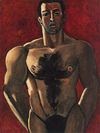
Hartley was an artist with a great love of great paintings who wanted to make his own & have them be viewed as great. He succeeded because he embraced life, painful as it was.
The seminude portraits of swimmers & wrestlers that he made in Maine in the late 1930's are among the most powerfully sexual images of men ever painted. Hartley was also an accomplished poet & essayist. It could not have been easy to face the difficulties of being a gay artist in an era when public admission was taboo & costly. His work is featured in the Hide/Seek exhibit at the Smithsonian Portrait Gallery, as is his portrait by his friend George Platt Lynes.

Photograph by George Platt Lynes
''I want to paint the livingness of appearances.”
